The Art of Leaving Room: Why Strategic Emptiness Is the Ultimate Design Luxury
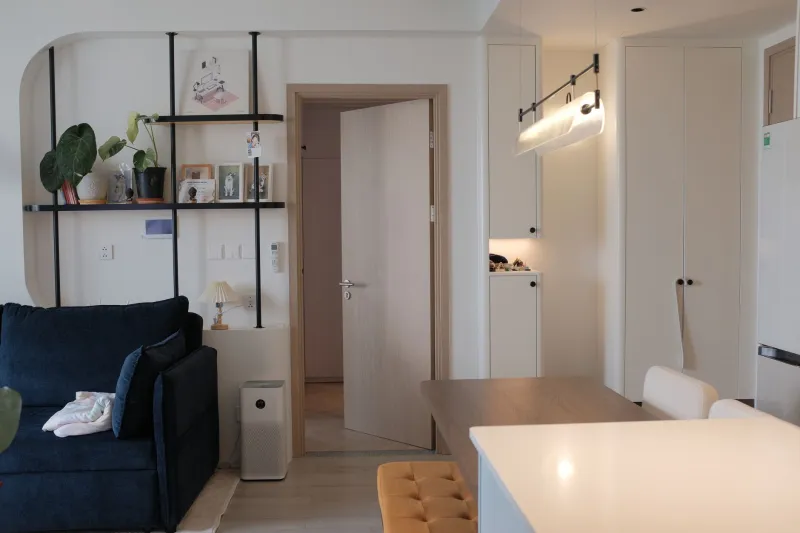
There is a particular kind of confidence that announces itself quietly. It does not crowd a room with objects or fill a closet to capacity. It leaves gaps. It breathes. In the most considered homes and wardrobes across the country, the defining characteristic is not what is present—it is what has been deliberately withheld.
This is the principle that architects and high-end interior designers have long understood: negative space is not wasted space. It is, in fact, the most purposeful space of all.
What Negative Space Actually Means
Borrowed from the visual arts, negative space refers to the area surrounding and between subjects. A sculptor considers the air around a form as carefully as the form itself. A graphic designer treats the white space on a page as an active compositional element, not a blank afterthought. In interior design, this same logic applies to the volumes of a room, the gaps between objects on a shelf, and the empty hangers in a well-edited closet.
Negative space creates contrast. Without it, the eye has nowhere to rest, no point of reference from which to appreciate what is present. A bookshelf packed wall to wall with objects communicates urgency, accumulation, perhaps even anxiety. A shelf with three carefully chosen objects and deliberate open intervals communicates something entirely different: intention, selectivity, and ease.
The distinction is not about minimalism as an aesthetic ideology. It is about the functional power of restraint.
The Closet as a Design Statement
Few domestic spaces reveal a person's relationship with abundance and restraint more candidly than a closet. Walk into a well-curated wardrobe and you will notice that the garments have room to hang without pressing against one another. The empty hangers are not placeholders for things not yet purchased—they are evidence of a disciplined editing practice.
Styling professionals who work with high-profile clients often cite overcrowding as one of the primary obstacles to dressing well. When a closet is at capacity, decision fatigue sets in before the day has properly begun. The eye cannot distinguish between options. Pieces that deserve attention are buried beneath pieces that no longer serve.
Leaving empty hangers is an act of forward thinking. It signals that additions will be made only when something genuinely earns its place—not because a sale was compelling or a trend was momentarily persuasive. In this way, the empty hanger functions as a standard, a placeholder for quality rather than quantity.
Open Shelving and the Discipline of Display
Open shelving has become one of the most discussed elements in contemporary American home design, appearing in kitchens, living rooms, home offices, and bedrooms alike. Its appeal is understandable: it creates visual accessibility and a sense of lightness. Its pitfall, however, is equally well-documented. Without a considered approach to what is placed on open shelves—and what is left off them—the result tips quickly from curated to cluttered.
The designers who execute open shelving most successfully apply a simple principle: every object displayed must justify its presence, and every gap must be as intentional as every placement. A ceramic vessel, a stack of two or three books with considered spines, a single botanical stem in a narrow vase. Then space. Then perhaps one more object. Then space again.
This rhythm of presence and absence is what gives a well-styled shelf its visual authority. The objects speak more clearly because they are not competing with a chorus of other objects for attention.
The Psychology of Spaciousness
Research in environmental psychology consistently finds that spatial crowding—whether physical or visual—elevates stress responses and reduces cognitive clarity. Americans, who statistically own more possessions per household than any other population on the planet, are particularly susceptible to the psychological weight of accumulated objects.
Conversely, environments with deliberate open space tend to produce measurable reductions in cortisol levels and improvements in focus. This is not coincidental. The brain processes visual information constantly, and a cluttered field of view demands continuous low-level processing. Space, by contrast, signals safety and sufficiency. It communicates that there is enough—that nothing needs to be added urgently.
Designing with negative space is, in this sense, an act of environmental self-care. It creates rooms and wardrobes that feel generous rather than pressured.
Practical Steps Toward Designed Breathing Room
Implementing this principle does not require a complete overhaul of your home or wardrobe. It begins with a single edited zone.
Start with one surface. Choose a console table, a nightstand, or a single shelf and reduce what sits on it by half. Live with that reduction for two weeks before making any further decisions. Observe how the space feels, how your eye moves across it, and what the remaining objects communicate now that they have room.
Apply the one-in, one-out framework—with a deliberate pause. Before adding anything new to a shelf or a closet, identify what will leave. Then wait forty-eight hours before completing either transaction. This pause interrupts the impulse cycle and allows genuine evaluation.
Treat empty space as a budget line. Just as a well-managed financial portfolio holds some liquidity in reserve, a well-designed space holds some visual capacity in reserve. Decide in advance what percentage of your shelf space or closet rod will remain open at any given time—many designers suggest between twenty and thirty percent—and treat that reserve as non-negotiable.
Edit seasonally, not just when things feel unmanageable. A seasonal review conducted from a position of calm produces better decisions than a purge conducted from a position of overwhelm. Approach each seasonal transition as an opportunity to reassess what earns its place and what has quietly stopped serving your aesthetic.
The Luxury of Less
There is a reason that the world's most aspirational retail environments—the flagship boutiques on Madison Avenue, the design showrooms in Chicago's Merchandise Mart—display their offerings with extraordinary spaciousness. Objects surrounded by negative space appear more significant. They are perceived as more valuable. The space itself becomes a form of reverence.
Applying this same logic to your own home and wardrobe is not an act of deprivation. It is an act of elevation. When you leave room in your closet, you are signaling—to yourself as much as to anyone else—that what remains is worth the space it occupies. When you leave a shelf partially bare, you are asserting that your home does not need to earn its beauty through accumulation.
The empty hanger. The open shelf. The unoccupied corner of a room. These are not failures of completion. They are marks of a design sensibility mature enough to understand that the most refined spaces always leave room to breathe.